

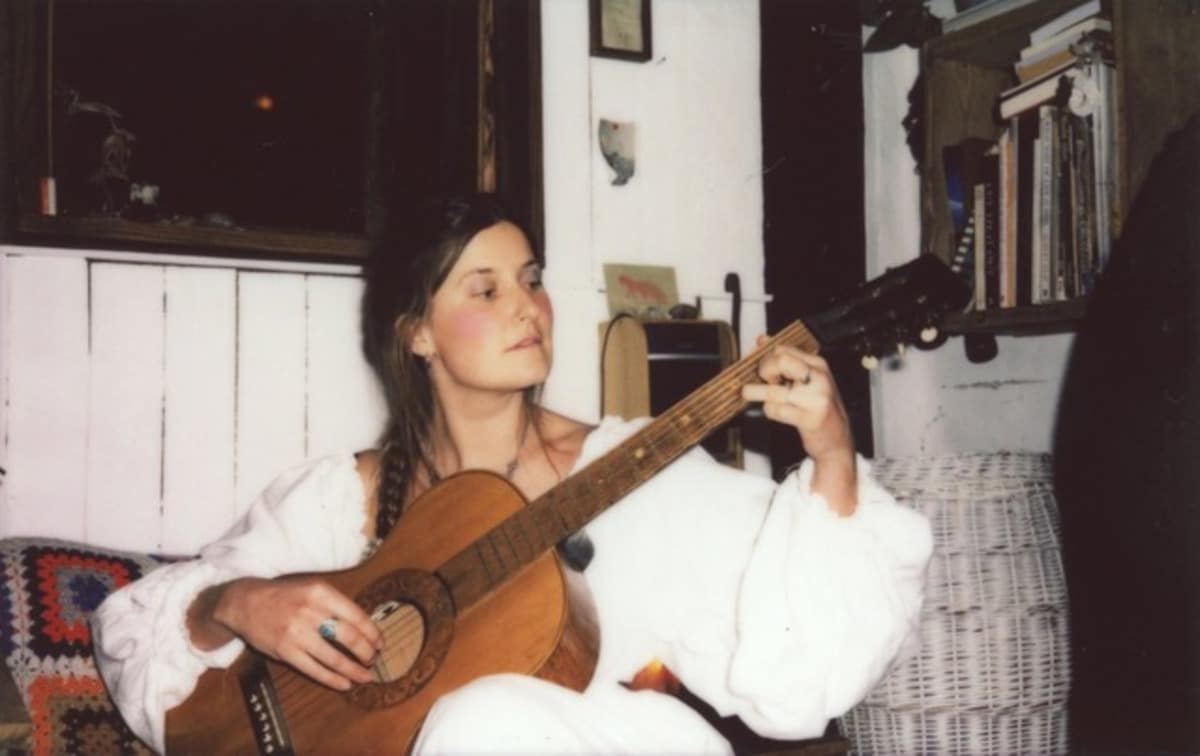

Camille Willemart, whose stage name is Camille Camille, has produced a stand-out LP in her newest release, Enchanted Sea. The Belgian artist is known for her left-field skew on a well-established folk sound, and on this album, she fulfils and perfects that brief, with the songs having a patience that indicates a detail-oriented approach to her art.
Opening piece Bottle Song feels like a nursery rhyme, establishing an intentional innocence early in the record that trickles down throughout each successive composition. The album traces a childlike wonder towards love and life in a paradoxically mature way. Le Vent, the first song on the album, sung in Camille’s native French, continues this trend but with a more obvious and traditional folk spin. Notably, this music does not take on a Midsommar-esque, spooky cult-folk atmosphere but is instead a more grounded, introspective and reflective style.
This pinch of realism allows the LP to be described accurately as raw, despite the meticulousness of the artistic approach. The Dove or The Devil is my pick of the bunch due to its ability to bridge that gap between listener and artist with its retention of authenticity through the added background static. This piece, encapsulating the album as a whole, is not powerful in its sound but is instead impactful in its self-reflection, which rubs off on you as the listener. Folk artists are often known for their spirituality, but it is rare that it rubs off on a listener in such a way. That roughness and readiness on this number begs for direct comparisons with early Dylan—a folk purist’s dream, I’m sure.
The second single from the album, J’ai Reve, as well as Dans Ce Paysage, are a reminder of the tantalising quality that the French language, when sung, has on an English speaker’s ears. On that second single, Camille says:
“To be honest, I had to dive into my voice memos to find the first drafts of ‘J’ai Rêvé’ and remember when and where it came to be. I was navigating a long-distance relationship. Life, and pretty much everything, felt so uncertain. The only thing I could hold on to was hope and trust that life would do its thing and bring us together again somewhere, someday.”
“After performing the song with just my guitar for a few years, I recorded the first demo at home in Ghent in 2024, where the song took a new turn. I started hearing marching band–like drums and flutes, as if they were played by angels descending straight from heaven, telling me that everything would be okay. With the help of my acolyte Felix Baele (bass/charango), my friend Orlan Ghekiere (drums), and the flute kid inside me, J’ai Rêvé, originally a sad sailor’s ballad, simultaneously became a joyful hymn to love and hope.”
Camille’s description here leads me to want to hear the stories of other songs. Her storytelling ability is clearly confined not only to lyrics.
Piano Song, not played on the bassoon, and Humming Song, which features no Sprechgesang, ditch the need for lyricism altogether and capture the imagination with a classical quality. The piano work on the former piece would no doubt be revered in any century. The latter composition closes the album and completes the circle of curiosity and beauty that traverses the whole LP.
This album does a fantastic job of charting the journey of a person trying, and perhaps failing, to connect properly with their immediate surroundings and to understand them. There is an innocence revealed by understanding and an inherent innocence in ignorance. Although this release does not push boundaries, it is the perfect encapsulation of the undying power of folk.
